From 1 April 2027, salary sacrificed tools, devices and work-related expenses lose their FBT concessions. We explain what construction employers should review.
What is changing, and when
From 1 April 2027, fringe benefits tax (FBT) will apply to several work-related benefits that employers can currently salary package with little or no FBT. The changes sit alongside the new standard deduction for work-related expenses, which the Treasury Laws Amendment (Tax Reform No. 1) Act 2026 introduced from the 2026–27 income year. The first year affected is the 2027–28 FBT year, which runs from 1 April 2027 to 31 March 2028.
Three terms come up throughout this article, so it helps to explain them up front:
- FBT is the tax an employer pays on benefits it provides to employees in place of, or in addition to, salary or wages.
- A salary sacrifice arrangement (also called salary packaging) is an agreement where an employee gives up part of their pre-tax salary and the employer provides a benefit of the same value instead.
- The standard deduction is a deduction of up to $1,000 that eligible employees can claim for work-related expenses from the 2026–27 income year, without itemising those expenses.
Construction businesses are most likely to be affected where employees salary package tools of trade, mobile phones, laptops and tablets, protective clothing, course fees, or home phone and internet costs. The FBT treatment of these items stays the same when the business provides them outside salary sacrifice.
Change 1: less FBT relief for salary sacrificed work expenses
When an employer pays or reimburses an expense that an employee has incurred, the payment is called an expense payment fringe benefit. The otherwise deductible rule reduces the taxable value of that benefit by the amount the employee could have claimed as an income tax deduction if they had paid the expense themselves. Under the current rules, a salary packaged reimbursement of a fully work-related expense can therefore attract little or no FBT.
From 1 April 2027, employers will no longer be able to use the otherwise deductible rule for an expense payment fringe benefit that meets all three of these conditions:
- The expense is work-related.
- The expense is of a type covered by the standard deduction.
- The benefit is provided through a salary sacrifice arrangement.
The ATO lists home office expenses, home phone and internet expenses, and self-education expenses as examples of affected payments and reimbursements. The change applies regardless of the value of the expense, so a salary packaged expense costing more than $1,000 is still affected.
Employers can still use the otherwise deductible rule for expenses the standard deduction does not cover, and for expenses it does cover that are paid or reimbursed outside salary sacrifice.
Change 2: salary sacrificed work-related items will lose their FBT exemption
Certain work-related items are currently exempt from FBT when they are provided mainly for work use. In construction, the exemption commonly covers the tools, phones and protective clothing that site staff use.
From 1 April 2027, the following items will no longer be exempt from FBT when they are provided through a salary sacrifice arrangement:
- portable electronic devices (such as mobile phones, laptops, tablets, portable printers and GPS units)
- computer software, protective clothing
- briefcases and tools of trade.
Unless another exemption applies, the employer will pay FBT on these items when an employee salary packages them. The items stay exempt when the business provides them outside salary sacrifice and they are used mainly for work.
Change 3: the one-item limit will be removed for items that are not salary sacrificed
Under the current rules, the work-related item exemption is limited to one item per employee per FBT year where the items have the same or a substantially identical function, unless the second item is a replacement. Businesses with aggregated turnover under $50 million are already exempt from that limit for portable electronic devices.
From 1 April 2027, all employers will be able to provide an employee with more than one exempt work-related item in the same FBT year, including items with the same or a substantially identical function, provided both of these conditions are met:
- The items are used mainly for work purposes.
- The items are not provided through a salary sacrifice arrangement.
From 1 April 2027, businesses with turnover under $50 million will also be able to provide more than one exempt item in the other categories, including tools of trade and protective clothing, provided the items are not salary sacrificed. Businesses with turnover of $50 million or more will be able to provide more than one exempt item of the same type in a year for the first time.
How the changes apply to common construction arrangements
The table compares the FBT position from 1 April 2027 for the same item provided in two ways: through salary sacrifice, or by the business outside salary sacrifice. Each example assumes the item is used mainly for work and no other exemption applies.
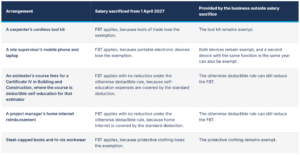
For each affected package, the business will need to choose whether to absorb the FBT, adjust the employee’s package, or provide the item outside salary sacrifice. Each option affects wages, superannuation and take-home pay differently, so the right choice depends on the business and the employee.
Preparing for the 2027–28 FBT year
The current FBT year ends on 31 March 2027, which gives businesses time to review existing arrangements before the changes start. The ATO recommends that employers review their salary sacrificed work-related benefits and work out which expenses the standard deduction covers. In practice, that review has four steps:
- The first step is listing every salary sacrifice arrangement in place (tools, devices, protective clothing, course fees, and home office or internet reimbursements) and identifying which ones the changes affect.
- The second step is working out how much FBT the business will pay on each affected arrangement in the 2027–28 FBT year.
- The third step is confirming the records the business needs to keep, including evidence that items provided outside salary sacrifice are used mainly for work.
- The fourth step is understanding the lodgement and payment obligations for the 2027–28 FBT year.
Employees with existing packages will need to know the impact the changes will have. The review is also a good time to plan how you will explain that impact to them.
Working through the changes with Xact
If your business salary packages tools, devices, protective clothing or work-related expenses, we can work through each arrangement with you and show you how it is treated from 1 April 2027. We can then help you compare your options and put the right records and processes in place before the new FBT year begins. To talk through your arrangements, please contact your Xact Client Director or get in touch with our team.
**This article contains general information only and does not take into account your business’s circumstances. Please seek advice specific to your situation before acting on it.