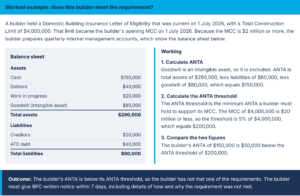
This example is illustrative. The figures were chosen to show how the calculation works and do not describe a real builder.
Sources: Consultation paper ‘Clear and Fair Financial Standards for Builders’ and the accompanying draft regulations; Minimum Financial Requirements and Administrative Guidelines 2026, Victoria Government Gazette S 365, 30 June 2026. NTA means Net Tangible Assets. ANTA means Adjusted Net Tangible Assets. ANTA threshold means the minimum ANTA a builder must hold to support its MCC. MCC means Maximum Construction Capacity. BPC means the Building and Plumbing Commission.
What the cap measures
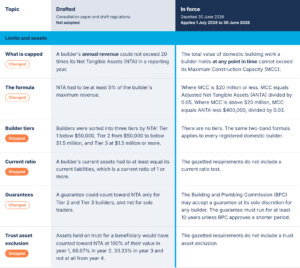
The cap is called Maximum Construction Capacity (MCC), which is the maximum total value of domestic building work a builder may hold at any point in time. The total includes every live insurable domestic building contract (in practice, any residential building contract that needs Home Warranty cover) at its contract price, and speculative building work at its market value once Home Warranty cover has started.
A contract stops counting on its completion date, which is usually the date the occupancy permit is issued. Because a contract counts in full from signing, a builder can reach its MCC before any work has started. A builder must plan for their pipeline, apply to increase its MCC before entering a contract that would take it over the limit.
The assets needed to support the cap
The cap is tied to a builder’s Adjusted Net Tangible Assets (ANTA), which is total assets less liabilities less disallowed assets. Where MCC is $20 million or less, ANTA must be at least 5% of MCC, so a builder holding $4 million of work needs ANTA of at least $200,000. Where MCC is above $20 million, ANTA must be at least 3% of MCC plus $400,000.
Goodwill and other intangible assets (such as customer lists and customised software), shares in unlisted companies and units in unlisted trusts do not count towards ANTA. Builders who trade through a trust or hold value in related entities should check how much of their balance sheet falls into these categories.
What applies to existing builders
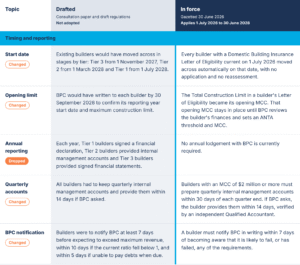
Every builder with a Domestic Building Insurance Letter of Eligibility current on 1 July 2026 moved onto the MFRs automatically, and the total construction limit in that letter became its opening MCC. The opening MCC stays in place until the BPC reviews the builder’s finances and sets an ANTA threshold (the minimum ANTA needed to support the MCC). The gazetted requirements do not say when the BPC will first review builders on a carried-over limit.
Three obligations apply from 1 July 2026, and no annual lodgement with the BPC is required.
- A builder with an MCC of $2 million or more must prepare internal management accounts for each quarter within 30 days of the quarter ending.
- A builder must give the BPC written notice within 7 days of becoming aware that it is likely to fail a requirement, or within 7 days of failing one.
- A builder must give the BPC the information it asks for within 14 days, including the quarterly accounts verified by an independent Qualified Accountant (a practising member of CPA Australia, Chartered Accountants Australia and New Zealand or the Institute of Public Accountants).
What happens if a builder falls short
Failing to meet the MFRs is grounds for disciplinary action, and the BPC must immediately suspend a builder’s registration if it reasonably believes the requirements are no longer being met. The BPC may, at its sole discretion, enter a written MFR Agreement with the builder, which replaces the standard requirements with agreed terms. Those terms can include a capital injection, a guarantee or a reduction in the value of work held.
Three checks that keep a builder ready for a BPC request
- A builder should know its current MCC and where it came from, which for an existing builder is the total construction limit in its Letter of Eligibility.
- A builder should calculate ANTA each quarter, leaving out goodwill, other intangible assets, unlisted shares and units in unlisted trusts.
- A builder should compare signed and proposed contracts with its MCC before signing the next contract, looking three to six months ahead.
BPC MFR Health Check
In a BPC MFR Health Check, we work through your balance sheet against the MFR formula with you. We show you your ANTA, how much room you have under your MCC, and which balance sheet items count. Please get in touch below or call Jack Armour on 0495 102 980 to learn more about our BPC MFR health check and what discounts are available to Master Builders Association of Victoria members.
Book a Health Check
Source: Minimum Financial Requirements and Administrative Guidelines 2026, Victoria Government Gazette S 365, 30 June 2026. This article is general information only.