Financial Clarity for Construction Businesses: The System That Changes Everything
Most builders know their trade inside out. They can read a set of plans, manage a subcontractor, and price a job from memory. But when it comes to their finances? Too many are flying blind.
If you have ever finished a job and wondered where the profit went, discovered a cash flow problem only after it became a crisis, or felt like your accountant speaks a language you do not understand, you are not alone. And more importantly, it is fixable.
At Xact Accounting, we have worked with builders, tradies, and construction business owners across Australia since 2015. The single most common gap we see is not a tax problem or a bookkeeping problem. It is a financial clarity problem.
This article explains what financial clarity actually means, why it matters more than ever, and how to build it in your business step by step.
What Is Financial Clarity?
Financial clarity is not just about knowing your bank balance. It means having accurate, timely, and meaningful information about how your business is performing, so you can make confident decisions without guesswork.
A builder with financial clarity can answer questions like:
- Which jobs are profitable and which are not?
- What is my gross margin this month compared to last month?
- Do I have enough cash to hire another tradie in 60 days?
- Am I on track to hit my profit target for the year?
A builder without financial clarity relies on gut feel, end-of-year tax returns, and whatever happens to be in the bank account today. That approach works until it does not.
The Five Levels of Financial Control
Financial clarity is not a single switch you flip. It is a system built in layers. Each layer depends on the one below it. We call this the Financial Control Journey, and it covers five interconnected areas.
-
The Transactional Layer: The Foundation of Everything
The transactional layer is where all financial data enters the system. Every invoice, every purchase order, every timesheet. If this layer is messy, every report, forecast, and decision built on top of it will be unreliable.
A tight transactional workflow in a construction business looks like this:
- Purchase orders first. Before any work is ordered or any material is bought, a PO is raised. This locks in price and terms, and it is the anchor point for tracking cost against estimate.
- Receipt capture via Dext. Invoices are captured, coded to the correct job and cost category, and flow automatically into Xero. No paper piles, no manual entry, no coding errors that snowball into month-end headaches.
- Matching in Xero. Every cost is reconciled against the original PO and the corresponding estimate line. Variances surface in real time, not at the end of the job when there is nothing left to act on.
- Timesheet allocation. Labour is coded to the correct job, stage, and cost category. The distinction between COGS and overhead matters: blur that line and gross margin becomes meaningless as a metric.
- A weekly rhythm. Bank reconciliation, AP/AR review, and PO matching done weekly keeps data clean and prevents backlogs from building up.
The power is not in any single tool. It is in how your estimating platform, Dext, and Xero run as one connected system.
-
Month-End Close and WIP: Turning Data Into a Reliable Picture
A clean transactional workflow produces accurate raw data. The month-end close is what turns that data into a reliable snapshot of where the business stands.
Without a structured close, your Profit and Loss is driven by invoice timing, not business performance. You might show a strong month simply because three claims landed at once, and a weak month when the pipeline was full but nothing had been invoiced yet. That is not information you can manage a business on.
The close process includes bank reconciliation, AP/AR reconciliation, payroll and super, unassigned P&L review, and prepayments and accruals.
The piece most builders are missing: the WIP calculation. WIP (Work in Progress) recognises the value of work completed but not yet invoiced. Without it, your monthly profit figure is unreliable, particularly mid-project. For Queensland builders, an inaccurate WIP can result in a breach of QBCC Minimum Financial Requirements. For all builders, it creates the classic “rollercoaster P&L” – huge swings in reported profit that have nothing to do with actual business performance.
-
The Reporting Pack: Numbers That Actually Mean Something
Once you have clean data and a tight close, you can build a reporting pack that drives real decisions rather than just satisfying compliance requirements.
A good construction reporting pack includes:
- Profit and Loss: Actual vs. budget, current month and year to date, with gross margin and net profit clearly separated.
- Job profitability summary: Every active project showing revenue, costs to date, estimated cost to complete, and current margin.
- WIP schedule: The complete WIP position across all active jobs, reconciled to the balance sheet.
- Cash flow statement: Where cash moved this month and why.
- AR/AP aging report: Who owes you money and how long, and what you owe and when it is due.
- Key ratios: Gross margin %, overhead %, and net margin % tracked against benchmarks and prior periods.
The benchmarks matter. Residential builders should be targeting a gross margin of 20% or more. Custom and renovation work should aim for 25% or above. Overheads should be in the single digits as a percentage of revenue. Net profit should be 10% or higher after all costs, including the owner’s wages at fair market value.
If you cannot see those numbers clearly and consistently every month, you are managing by feel, not by data.
-
Budgeting and Forecasting: Knowing Where You Are Going
The reporting pack tells you where you have been. Budgeting and forecasting tell you where you are going.
Builders who do not have this are making their biggest decisions (hiring, tendering, spending) based on what is in the bank today rather than what is coming down the pipeline.
The key distinction: a job estimate prices a specific project. A business budget maps the entire income and cost position across the next 12 months. Builders regularly confuse the two, and the gap that creates is expensive.
A rolling 12-month budget is built from the ground up: confirmed projects loaded by expected claim month, overheads mapped against them, payroll, tax, and debt obligations included. COGS is kept clearly separate from overheads so that gross margin and net profit are visible month by month, not just as a year-end figure.
The budget is a living document. It is updated every month, not set once and forgotten. New projects are added as won, delays are adjusted, and assumptions are updated as conditions change.
Pipeline visibility also matters here. Map your pipeline across three buckets: Contracted (confirmed revenue), In Tender (probability-weighted), and Prospective (early stage). Without this visibility, builders either overcommit or have gaps they do not see until cash is already tight. Both outcomes are expensive.
-
Resourcing Your Finance Function: The Right Team for the Right Stage
The five areas above represent three distinct levels of finance function capability. Most construction businesses are under-resourced at all three.
- Level 1 – Transactional/Bookkeeping: The engine room. This needs construction-specific expertise, not a generalist who has never heard of a PO or a WIP schedule. You are looking for an industry-specialist bookkeeper who understands job costing, cost categories, and the link between your estimating platform and your accounting software.
- Level 2 – Month-End Close and Reporting: Where data becomes information. This requires a senior hand to ensure the close is done correctly, WIP is calculated accurately, and the reporting pack tells a true story. This role is typically outside the capability of a bookkeeper and requires someone with a Financial Controller background.
- Level 3 – CFO Advisory/Strategic Finance: Budgeting, forecasting, variance analysis, and the commercial conversations that drive growth decisions. A good Financial Controller can assist here, but ideally you want someone with CFO-level experience in a larger business ($50M-plus) to help you navigate the complexities of scaling.
The question most builders ask next is: how much does this actually cost? That is where the numbers get interesting.
How Much Should You Pay for Good Talent?
This is where most builders get stuck, because good finance talent is not cheap. Here is what the market looks like for full-time, in-house hires compared with a fractional (outsourced) model:
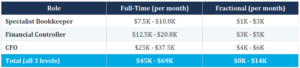
The numbers speak for themselves. Full coverage across all three levels of the finance function, through a fractional model, costs roughly $8K to $14K per month. That is less than what a single full-time Financial Controller would cost you on salary alone.
Important: Why Fractional Makes Even More Sense Than the Numbers Suggest
As an external service, fractional finance is 100% tax deductible as a business expense. Unlike an employee, there are no added costs for superannuation, annual leave, sick leave, workers compensation, payroll tax, or management overhead. The total cost is the monthly fee, and nothing more.
There is also a hiring reality that most builders face: finding quality finance talent with genuine construction experience is extremely difficult. The talent pool is small, demand is high, and if you do not already know what good looks like in a finance role, you are just as likely to hire the wrong person as the right one. A fractional model removes that risk entirely. You get proven, specialist capability from day one, without the cost or gamble of a bad hire.
The fractional model does not just save money. It gives you access to senior-level expertise you would never be able to justify hiring full-time at your current scale. You get the right capability at the right level, without carrying headcount you cannot sustain.
One non-negotiable regardless of your model: the owner’s financial literacy. You do not need to do the journals. But you do need to understand how the system works, what each role does, how the tools connect, and what good looks like. The most common reason businesses struggle with their finance function, despite having a bookkeeper or an accountant, is that the owner has abdicated rather than delegated.
Ready to Find Your Financial Clarity Gaps?
The first step is a diagnosis. Where are you strong? Where are the gaps? And what one action, taken in the next 30 days, would have the biggest impact on your numbers?
We offer a free one-on-one consultation to review your current position and prioritise where to start.

Insights and Resources
Blog
30 June 2026Tax Reform Update