Getting Into Property Development?
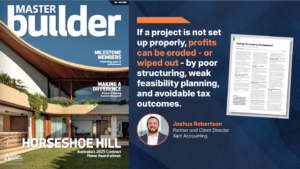
As published in the January-March 2026 issue of Master Builder Magazine.
With the property market continuing to power on, particularly in the lead up to the Olympics, many business owners already in the industry are looking at property development and thinking, “Why wouldn’t I?”. With access to people, subcontractors, equipment and real delivery capability, it can feel like a natural extension of the business and a way to capture upsides others seem to enjoy.
The opportunity is real. But so is the warning. If a project is not set up properly, profits can be eroded – or wiped out – by poor structuring, weak feasibility planning, and avoidable tax outcomes.
More importantly, if development activity is tangled up with the main trading company, and you do not have strong financial visibility across your existing operations, a single decision or dispute can put the core business at risk.
Set the strategy – and the numbers – before any dirt is turned
Before getting excited about a site, a design, or a selling price, decide the strategy and test it commercially.
Most development activity falls into two broad models:
- Build and hold – Create a portfolio, earn rental income, and target long-term value growth. This relies on sustainable cash flow and gearing that can be serviced in tough markets.
- Develop and sell – Acquire, develop, and sell within a shorter timeframe. This is about disciplined cost control, time management, and execution.
“If a project is not set up properly, profits can be eroded – or wiped out – by poor structuring, weak feasibility planning, and avoidable tax outcomes.”
These models can look similar on paper, but they drive different decisions around funding, tax treatment, and risk. Before committing, run proper feasibility models: realistic build costs, contingencies, finance, holding and selling costs, and conservative sale or rental values. Stress test the deal—what happens if rates rise, sales slip, or costs blow out? If the strategy and feasibility are unclear from day one, it is easy to build yourself into an outcome you did not intend.
Decide who is actually doing the development
Early on, decide whether the activity sits with you personally or inside a separate entity. This influences how profits are taxed, how lenders assess the deal, and how effectively risk can be kept away from the operating business.
Structure also changes how cash moves – who contributes equity, who borrows, who receives sale proceeds. With your advisers, select the mix of entities – company, trust, or otherwise – that best aligns tax outcomes, funding, and risk containment.
Collaboration can work, but only with clear commercial rules
One pathway into development is partnering with other parties who bring different assets or expertise – land, capital, or sales capability – while you contribute construction delivery
or project management.
Partnerships are a great way to achieve scale, but partnerships need grown-up paperwork. Roles, contributions, decision rights, profit splits, and exit scenarios must be agreed upfront. Go further and set budgets, approval thresholds, reporting, and who is responsible if costs overrun or timelines slip. Trust matters, but clear agreements matter more.
Funding is a strategy, not a formality
Development funding is different to standard business lending. Lenders look closely at feasibility, pre-sales or pre-leases, program, and cost to complete, not just security.
The key question is whether the funding structure supports how cash actually moves through the project. How much equity goes in, when do debt drawdowns occur, what pre sales are required, and what tests or covenants apply during the build? A development can be profitable on paper and still put pressure on cash flow if timing is misaligned
Protect the core business and manage the project like a client job
One principle matters above all others: the main trading company should not be carrying development risk.
Best practice is to use structures that isolate risk and limit the chance that defects, disputes, or claims arising years later affect the operating business, with strong contracts between all parties, including where your construction business is engaged to deliver the build on arm’s length terms.
Development can also quietly strain the core business if it pulls focus, people, and cash away from client work. Even solid projects can take longer than expected, tie up working capital, or create short-term cash pressure.
So, run your own development with the same discipline you expect from good clients: clear scope, a realistic program, cost to complete reporting, a live risk register, and regular reviews of margin and cash flow across both the project and the wider business. You need to see how development activity is affecting working capital and operational capacity. Without that visibility, risk builds quickly.
Build a trusted commercial advisory circle early
The strongest outcomes usually come from construction businesses that surround themselves with the right people early – not just accountants and lawyers, but also finance partners who understand development, town planners, buyers’ agents and real estate professionals with genuine market insight, and financial advisers where appropriate.
The best time to assemble that trusted advisory circle is before you commit. Once contracts are signed, your options narrow fast.
Property development can be a powerful way to build long-term value, but only when it is approached strategically. Get the structure right up front, invest in serious feasibility and project management, protect the core business, and make decisions with clear eyes rather than optimism alone.