Current as of 6 August 2026
Treasury has released the next tranche of draft legislation, giving us the first real detail on two points this article had flagged as still moving.
The new build window has been extended. A property will generally still count as new if it is bought within 24 months of the certificate of occupancy being issued, up from the 12 months set out at Budget time. That gives builders and developers more time to sell completed stock without the buyer losing access to the 50% discount choice.
Treasury has also released a draft method for apportioning the gain across the 30 June 2027 line for property and other assets without a quoted market price. This will sit alongside a full market valuation as an alternative way to work out where that line falls in dollars.
Early indications are that the method leans toward a time-based split: working out the total gain across the whole ownership period, then apportioning it by how many days were held before and after 1 July 2027, rather than pinning down an actual value on the day. If that holds, it would suit an asset that grew steadily. It could work against you where most of the value was added in a short burst, which is common on development sites and part-built projects. We’d treat this as indicative only until the instrument itself is published.
Both are still exposure drafts, open for consultation until 21 August 2026, so treat them as the current direction rather than settled law. We are watching this closely and will update this article again once the detail is locked in.
If you own the yard your business runs from, a commercial unit leased back to the trading entity, land sitting on the books for a future project, or a dwelling you built and decided to keep, the tax on the eventual sale is changing. The reform passed on 25 June 2026 and takes effect on 1 July 2027, which leaves the better part of a year to get ready. Almost none of that preparation involves changing the way you are set up. Most of it involves knowing what you own and what it is worth.
What has changed
From 1 July 2027 the 50% capital gains discount ends for individuals, trusts and partnerships. In its place, your original purchase price is lifted in line with inflation, so tax applies only to the growth above CPI rather than to the part of the gain that simply kept pace with prices. A minimum rate of 30% then applies to that real gain. Companies never had access to the discount, so nothing changes for assets held in a company, and superannuation funds are treated differently again.
First, work out whether this is your problem at all
Before going any further, be clear about which side of the line your property sits on. If you are a developer and the land is part of the development business, held for subdivision, construction and resale, the profit on sale has always been ordinary income rather than a capital gain. You never had the 50% discount on it, so indexation and the 30% floor do not change your position on those projects.
The changes bite on assets held on capital account. That means the yard, the shed, the office, the unit rented to the trading entity, the townhouse that was built for sale and ended up being retained and leased, the block bought years ago with no firm plan attached to it. A lot of construction groups hold both kinds of asset, sometimes inside the same entity, and the distinction is not always as clean in practice as it looks in the accounts. It is worth settling that question now, because it decides whether the rest of this applies to you.
The reset at 30 June 2027
Every CGT asset you hold on 30 June 2027 is treated as though you sold it that day and bought it back at market value. It happens automatically. There is no election to make, no form to lodge, and no tax falls due on the day, because the gain built up to that point is worked out and then held over until you actually sell. In effect the law draws a line through the middle of your ownership period. Growth to the left of the line keeps the 50% discount. Growth to the right is indexed and carries the 30% floor.
What the law does not do is tell you where that line sits in dollars. For listed shares the closing price on the day settles it. For a yard in an industrial estate, a commercial unit or a part-built project, you need a valuation that would still hold up if the ATO asked about it years after the event, which in practice means a written report from a registered valuer rather than an agent’s appraisal or a rates notice.
What it looks like on a real asset
Take a builder who bought the commercial unit the business operates from in 2015 for $400,000. At 30 June 2027 it is worth $700,000, and the unit is sold in August 2029 for $760,000. The total gain across the whole period is $360,000, and it is taxed in two parts.
The $300,000 of growth up to 30 June 2027 keeps the current treatment, so the 50% discount applies and $150,000 is taxable. The $60,000 of growth after the reset is measured against an indexed cost base. At inflation of 2.5% a year, indexation absorbs roughly $35,400 of that, leaving about $24,600 exposed, and that part is taxed at no less than 30%. Across both periods the taxable amount comes to around $174,600, all of it assessed in the year the unit is sold. Under the old rules, the same $360,000 gain would have produced $180,000 of taxable income, so on these numbers the two systems land in much the same place.
That similarity is a feature of these particular figures and nothing more. Stretch the holding period out, or run it through a stretch of higher inflation, and indexation can beat the old discount comfortably. Compress it into a few years of low inflation and the 30% floor is the harder outcome, because there is little inflation for the cost base to absorb and no discount left to soften what is left. Which side of that you land on depends on your own dates and your own numbers.
Where the small business concessions fit
The small business CGT concessions came through the reform intact, and one of them improved. From 1 July 2027 the turnover threshold for the 50% active asset reduction lifts from $2 million to $10 million, which brings a large number of construction businesses inside it for the first time. Where a trading entity operates out of premises owned by a related entity, that is worth looking at properly, because on a business premises the concessions can move the final number more than the choice between discount and indexation ever will. The tests are detailed and they turn on facts: whether the asset is genuinely active, and how turnover aggregates across connected entities and affiliates. Aggregation is where these claims most often come unstuck, particularly in groups running several entities.
If you build and hold
There is one feature aimed squarely at new supply. For new residential builds, the owner chooses at the time of sale between keeping the 50% discount and using indexation, with the 30% minimum applying if indexation is chosen. If part of your model is building and retaining stock, that election is worth modelling before you commit to how the next project is held. The definition of what counts as a new build is being set in separate rules that are not yet finalised, so treat that detail as still moving.
Between now and 30 June 2027
None of this necessarily calls for a restructure. It calls for a proper stocktake. List the assets the reset will touch, which for most construction groups means the premises, any investment property, land held on capital account, shares and the goodwill in the business itself. Work out which of those need a formal valuation and which can be evidenced another way. If a sale was already on the cards, model it on both sides of 1 July 2027 before deciding when to go to market. And check whether the active asset and turnover tests are within reach, because on a business premises that single question can matter more than everything else on this page.
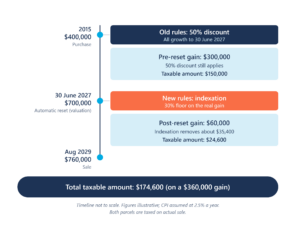
Figures used here are illustrative. The outcome on any particular asset depends on its own dates, values and ownership.
Our team worked through the CGT changes in detail in the Xact Masterclass: Tax Reforms webinar, and the replay is available here.
If you want to know where you actually stand, talk to us. We will map your assets against the reset date and tell you which of them need work before June 2027, and which ones you can leave alone.